
A Disappointment
 MR. ATTORNEY-GENERAL had to inform the jury, that the prisoner before them, though young in years,
was old in the treasonable practices which claimed the forfeit of his life. That this correspondence with
the public enemy was not a correspondence of to-day, or of yesterday, or even of last year, or of the
year before. That, it was certain the prisoner had, for longer than that, been in the habit of passing and
repassing between France and England, on secret business of which he could give no honest account.
That, if it were in the nature of traitorous ways to thrive (which happily it never was), the real wickedness
and guilt of his business might have remained undiscovered. That Providence, however, had put it into
the heart of a person who was beyond fear and beyond reproach, to ferret out the nature of the prisoner's
schemes, and, struck with horror, to disclose them to his Majesty's Chief Secretary of State and most
honourable Privy Council. That, this patriot would be produced before them. That, his position and attitude
were, on the whole, sublime. That, he had been the prisoner's friend, but, at once in an auspicious and
an evil hour detecting his infamy, had resolved to immolate the traitor he could no longer cherish in his
bosom, on the sacred altar of his country. That, if statues were decreed in Britain, as in ancient Greece
and Rome, to public benefactors, this shining citizen would assuredly have had one. That, as they were
not so decreed, he probably would not have one. That, Virtue, as had been observed by the poets (in
many passages which he well knew the jury would have, word for word, at the tips of their tongues; whereat
the jury's countenances displayed a guilty consciousness that they knew nothing about the passages),
was in a manner contagious; more especially the bright virtue known as patriotism, or love of country.
That, the lofty example of this immaculate and unimpeachable witness for the Crown, to refer to whom
however unworthily was an honour, had communicated itself to the prisoner's servant, and had engendered
in him a holy determination to examine his master's table-drawers and pockets, and secrete his papers.
That, he (Mr. Attorney-General) was prepared to hear some disparagement attempted of this admirable
servant; but that, in a general way, he preferred him to his (Mr. Attorney-General's) brothers and sisters,
and honoured him more than his (Mr. Attorney-General's) father and mother. That, he called with confidence
on the jury to come and do likewise. That, the evidence of these two witnesses, coupled with the documents
of their discovering that would be produced, would show the prisoner to have been furnished with lists of
his Majesty's forces, and of their disposition and preparation, both by sea and land, and would leave no
doubt that he had habitually conveyed such information to a hostile power. That, these lists could not
be proved to be in the prisoner's handwriting; but that it was all the same; that, indeed, it was rather the
better for the prosecution, as showing the prisoner to be artful in his precautions. That, the proof would
go back five years, and would show the prisoner already engaged in these pernicious missions, within a
few weeks before the date of the very first action fought between the British troops and the Americans.
That, for these reasons, the jury, being a loyal jury (as he knew they were), and being a responsible jury
(as they knew they were), must positively find the prisoner Guilty, and make an end of him, whether they
liked it or not. That, they never could lay their heads upon their pillows; that, they never could tolerate
the idea of their wives laying their heads upon their pillows; that, they never could endure the notion of
their children laying their heads upon their pillows; in short, that there never more could be, for them or
theirs, any laying of heads upon pillows at all, unless the prisoner's head was taken off. That head Mr.
Attorney-General concluded by demanding of them, in the name of everything he could think of with a
round turn in it, and on the faith of his solemn asseveration that he already considered the prisoner as
good as dead and gone.
MR. ATTORNEY-GENERAL had to inform the jury, that the prisoner before them, though young in years,
was old in the treasonable practices which claimed the forfeit of his life. That this correspondence with
the public enemy was not a correspondence of to-day, or of yesterday, or even of last year, or of the
year before. That, it was certain the prisoner had, for longer than that, been in the habit of passing and
repassing between France and England, on secret business of which he could give no honest account.
That, if it were in the nature of traitorous ways to thrive (which happily it never was), the real wickedness
and guilt of his business might have remained undiscovered. That Providence, however, had put it into
the heart of a person who was beyond fear and beyond reproach, to ferret out the nature of the prisoner's
schemes, and, struck with horror, to disclose them to his Majesty's Chief Secretary of State and most
honourable Privy Council. That, this patriot would be produced before them. That, his position and attitude
were, on the whole, sublime. That, he had been the prisoner's friend, but, at once in an auspicious and
an evil hour detecting his infamy, had resolved to immolate the traitor he could no longer cherish in his
bosom, on the sacred altar of his country. That, if statues were decreed in Britain, as in ancient Greece
and Rome, to public benefactors, this shining citizen would assuredly have had one. That, as they were
not so decreed, he probably would not have one. That, Virtue, as had been observed by the poets (in
many passages which he well knew the jury would have, word for word, at the tips of their tongues; whereat
the jury's countenances displayed a guilty consciousness that they knew nothing about the passages),
was in a manner contagious; more especially the bright virtue known as patriotism, or love of country.
That, the lofty example of this immaculate and unimpeachable witness for the Crown, to refer to whom
however unworthily was an honour, had communicated itself to the prisoner's servant, and had engendered
in him a holy determination to examine his master's table-drawers and pockets, and secrete his papers.
That, he (Mr. Attorney-General) was prepared to hear some disparagement attempted of this admirable
servant; but that, in a general way, he preferred him to his (Mr. Attorney-General's) brothers and sisters,
and honoured him more than his (Mr. Attorney-General's) father and mother. That, he called with confidence
on the jury to come and do likewise. That, the evidence of these two witnesses, coupled with the documents
of their discovering that would be produced, would show the prisoner to have been furnished with lists of
his Majesty's forces, and of their disposition and preparation, both by sea and land, and would leave no
doubt that he had habitually conveyed such information to a hostile power. That, these lists could not
be proved to be in the prisoner's handwriting; but that it was all the same; that, indeed, it was rather the
better for the prosecution, as showing the prisoner to be artful in his precautions. That, the proof would
go back five years, and would show the prisoner already engaged in these pernicious missions, within a
few weeks before the date of the very first action fought between the British troops and the Americans.
That, for these reasons, the jury, being a loyal jury (as he knew they were), and being a responsible jury
(as they knew they were), must positively find the prisoner Guilty, and make an end of him, whether they
liked it or not. That, they never could lay their heads upon their pillows; that, they never could tolerate
the idea of their wives laying their heads upon their pillows; that, they never could endure the notion of
their children laying their heads upon their pillows; in short, that there never more could be, for them or
theirs, any laying of heads upon pillows at all, unless the prisoner's head was taken off. That head Mr.
Attorney-General concluded by demanding of them, in the name of everything he could think of with a
round turn in it, and on the faith of his solemn asseveration that he already considered the prisoner as
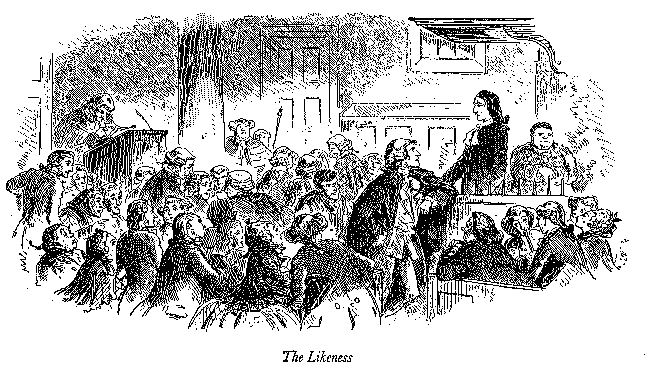
good as dead and gone. When the Attorney-General ceased, a buzz arose in the court as if a cloud of great blue-flies were swarming about the prisoner, in anticipation of what he was soon to become. When toned down again, the unimpeachable patriot appeared in the witness-box.
Mr. Solicitor-General then, following his leader's lead, examined the patriot: John Barsad, gentleman, by name. The story of his pure soul was exactly what Mr. Attorney-General had described it to be- perhaps, if it had a fault, a little too exactly. Having released his noble bosom of its burden, he would have modestly withdrawn himself, but that the wigged gentleman with the papers before him, sitting not far from Mr. Lorry, begged to ask him a few questions. The wigged gentleman sitting opposite, still looking at the ceiling of the court.
| Previous chapter | Back | Home | Email this | Search | Discuss | Bookmark | Next chapter/page |